
How to Dress a Fuller Figure (With Confidence, Not Compromise)
Larger women are often advised to:
Wear black. Hide this. Avoid that. Create the illusion of…
It’s often well-meaning but it can leave you feeling as though your body is something to work around, rather than something to dress.
A better place to begin is this: your body is not a problem to solve. It’s simply the form your style lives on. That’s why I start all my style consultations with a style personality quiz so that we can find out more about what clothing style will make you feel your best.
And once you understand your style personality, getting dressed becomes less about restriction—and much more about ease, presence, and a sense of self.
Start with how you want to feel, not what you’re “meant” to wear
Before thinking about shapes or “flattering” cuts, ask something simpler:
How do you want to feel in your clothes?
Comfortable? Pulled-together? Slightly polished but still relaxed? A bit more bold than usual?
This matters more than any style rule. Because when clothes feel right, they look right—and that confidence is always more attractive than any so-called optical trick.
Fit matters more than the size on the label
One of the frustrations of shopping is how inconsistent sizing can be. It’s easy to get caught up in the number—but it rarely tells the full story.
What makes the difference is fit: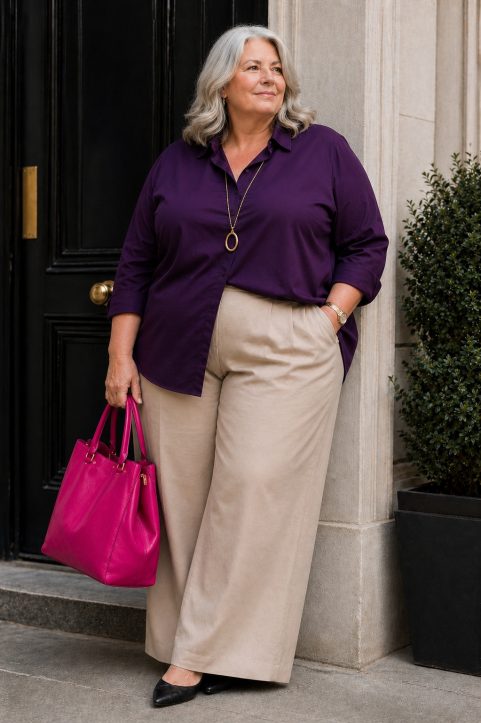
- Clothes that skim rather than cling or pull
- Waistbands that sit comfortably (not digging in or slipping down)
- Shoulders that align properly
- Fabric that moves with you
If something fits well, it will always look more considered and stylish. And, if the size on the label offends you, you can always cut it out!
Dressing well is about is about balance, not hiding
A common mistake that larger (and some smaller) women make is that they seek to disguise their shape altogether in shapeless, tent-like garments. Instead, I would encourage you to play with balance and proportion in a way that feels intentional and makes you feel confident.
A few suggestions:
- If something is more fitted on top, you might prefer a looser shape below (and vice versa)
- Defining the waist (whether subtly or clearly) can bring structure if you want it
- Longer lines (like open shirts, coats, or cardigans) can create a sense of flow and streamline your look
Fabric makes more difference than you think
Two garments in the same shape can feel completely different depending on the fabric.
Often worth looking for:
- Fabrics with a bit of weight—they tend to drape more smoothly
- Slight stretch for comfort and ease of movement
- Materials that don’t cling too tightly
Stiff or overly thin fabrics can sometimes make things feel less comfortable or less fluid so it’s worth paying attention here.
Don’t be afraid of colour or pattern
There’s a persistent idea that darker colours are always more “flattering.” Whilst they have their place can certainly look chic, they’re not the only option so don’t feel you have to wear them head to toe. In fact, colour can not only lift an outfit, but also your face and your mood.
If you enjoy it:
- Try introducing colour through one piece at a time, particularly to a part of your body you feel most confident about
- Use prints in a scale that feels right to you. There’s no universal “correct” size but larger scale prints can look particularly good on plus size bodies.
- Pair bolder items with something simple to keep things balanced
You don’t have to disappear into your clothes to look put-together. Feel free to express your personality and wear what brings you joy!
Accessories: small details that can shift everything
Accessories are often treated as an afterthought, but they can bring balance, polish, and personality to an outfit. Better still, they always fit regardless of weight fluctuations!
A few things to keep in mind:
- Scale can help create harmony
Very delicate pieces can sometimes feel a little lost against fuller silhouettes. Slightly bolder jewellery—chunkier chains, wider bangles, statement earrings—can feel more in proportion. Not oversized for the sake of it, just balanced. - Belts can define shape, if that’s what you want
A well-placed belt can gently highlight the waist or add structure to looser pieces like dresses or longer tops. - Bags make a visual difference
Much like jewellery, extremely small bags can feel out of scale. Medium to larger styles tend to sit more naturally with your overall look—and are usually more practical too. - Shoes ground the outfit
A slightly chunkier sole or a shoe with a bit of presence can balance proportions nicely, especially with wider-leg trousers or longer hemlines. - Scarves and layering pieces add movement
A softly draped scarf or an open jacket can create vertical lines and a sense of flow, without feeling forced or “styled.” Scarves are also an easy way to add colour and interest to your outfit and draw attention to your face.
Pay attention to what what feels visually and physically comfortable to you, and to use accessories as a way of finishing off and personalising your outfit.
Undergarments are part of the outfit (whether we notice them or not)
It’s not about control – it’s about support and comfort. That’s why I’m not a fan of constrictive shapewear. Simply wearing a well-fitting bra and smoothing slip can make all the difference to how clothes sit and skim, no restriction required!
When the foundation feels right, everything else tends to fall into place more easily. on a daily basis.
Develop a few reliable outfit formulas
Getting dressed becomes much simpler when you know what works for you.
For example:
- A well-fitting pair of trousers + a soft, slightly structured top
- A midi dress + a layer (jacket or cardigan)
- Dark denim + a blouse + simple accessories
These aren’t meant to be limiting, they’re just starting points you can return to on days when you don’t want to overthink it.
Looking good, rather than slimmer, should be your goal
We are not looking to diminish you, we’re aiming to make you look and feel your very best.
That’s about:
- Feeling at ease in your clothes
- Moving comfortably through your day
- Being true to yourself
After all, women are at their most attractive when they feel confident and authentic in their clothes.
A final thought
Style is never about hiding away. It’s about dressing in a way that makes you feel good about yourself.